Have you ever wondered how locals survive the morning after a heavy night out in Seoul? If you are exploring South Korea’s vibrant nightlife, understanding local recovery methods is just as important as the food.
So, you survived the BTS Concert. Or maybe you spent a wild night out in Hongdae (홍대) or Itaewon (이태원). You sang, you danced, and you drank way too much Soju (소주).
👉 (Wait, did you mix drinks? If you tried the “Soju Bomb” we taught you, you are probably regretting it right now. [How to Mix Somac: The Golden Ratio Guide])
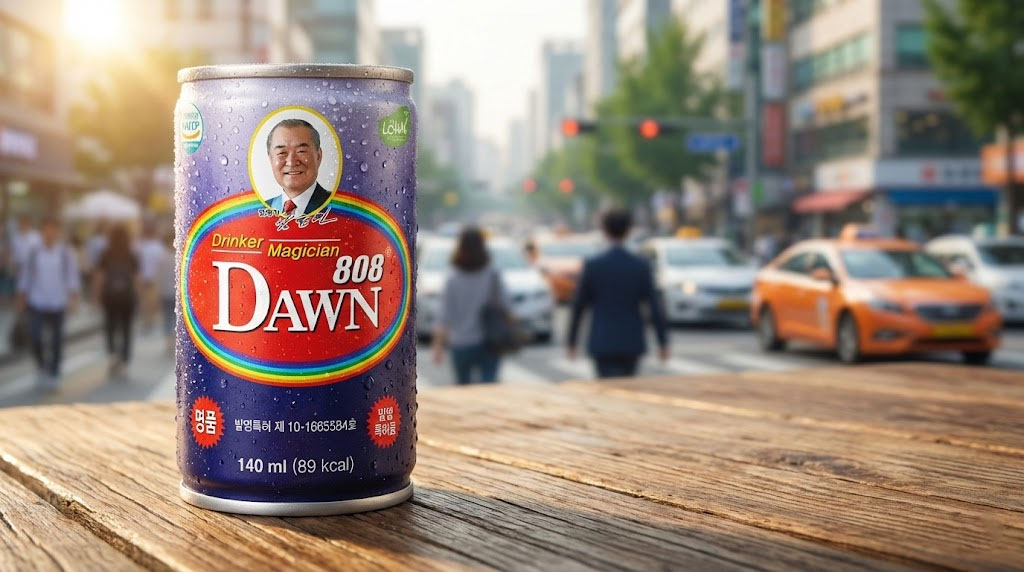
When the morning arrives and the sunlight hurts your eyes, you might assume the day is ruined. But in Korea, nightlife is a marathon, and recovery is taken very seriously. If you walk into any local convenience store, you will find a golden can that looks like an ancient elixir. It has a photo of a smiling middle-aged man on it.
This is “Dawn 808” (여명808). Locals often jokingly call it the “Magic Potion.” Here is everything you need to know about the legendary Korean hangover cure drink Dawn 808 and why it is a cultural phenomenon.
1. The Face of Confidence: Who is this Man?
The first thing you will notice is the unique packaging. Unlike modern energy drinks with sleek designs, this traditional can features a real, unedited photo of the inventor, Dr. Nam Jong-hyun.
In Korean business culture, there is an unspoken rule: “If the creator puts their face on the product, they guarantee its quality.” The inventor’s confident image became part of the product’s unique branding. The number “808” allegedly represents the fact that he succeeded on his 808th formulation experiment. Thanks to his immense dedication, it has become a staple of Korean recovery culture.
2. The Taste: A Friendly Warning
To understand the authentic cultural experience, you must be prepared for the taste. It is widely known that it does not taste like a sweet beverage.
Many foreigners and locals describe the taste profile as:
- “Liquid dirt.”
- “Burnt herbal medicine mixed with honey.”
- “The taste of regret.”
It is brewed from natural traditional ingredients like alder tree extracts and licorice root. It is thick, dark brown, and highly herbal. However, in traditional Korean medicine, there is a saying: “Good medicine tastes bitter to the mouth.”
3. How the Korean hangover cure drink Dawn 808 Works
It has remained popular for decades, especially among office workers and late-night diners. Many Korean office workers swear by a specific routine when consuming the Korean hangover cure drink Dawn 808 to survive early morning meetings:
- Temperature matters: It is strictly consumed ice cold from the convenience store fridge (drinking it warm makes the herbal taste too intense).
- Timing: It is consumed either right before drinking alcohol as part of a personal routine before drinking, or immediately the next morning.
The drink contains herbal extracts that are traditionally believed to help people feel more refreshed the next morning. Many locals say it helps them feel more settled and ready to start the day again.
4. Alternatives: Condition, Morning Care, and IdH
If the strong traditional herbal taste is too intense, the Korean convenience store fridge offers an entire ecosystem of modern, tastier recovery alternatives:
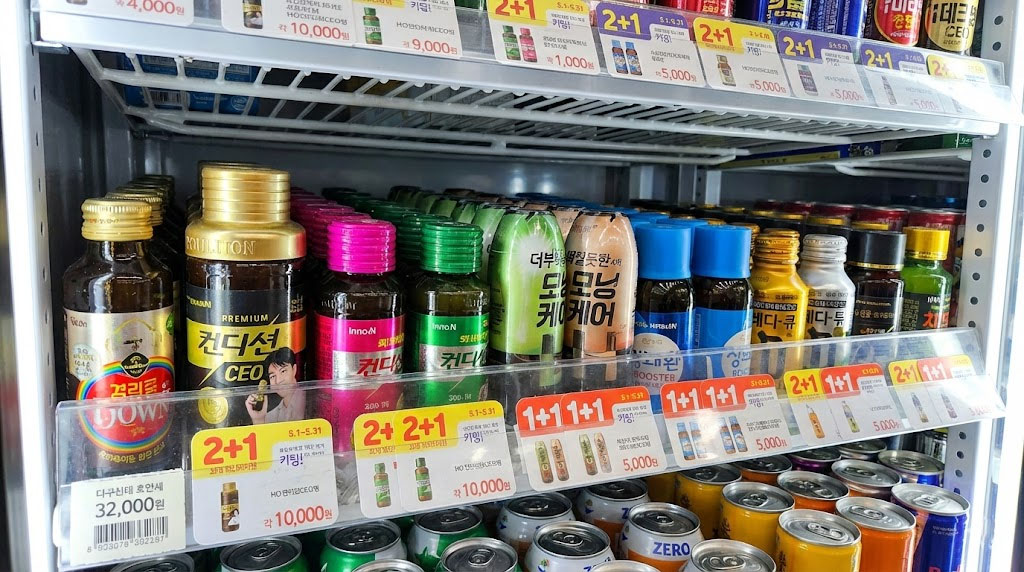
- Condition (컨디션): The most famous brand. Tastes like a sweet fruit punch with a hint of medicine. Good for mild hangovers.
- Morning Care (모닝케어): Uses turmeric and milk thistle. Tastes like yogurt medicine.
- Ru 21: These are pills, not a drink. Good for people who hate liquid medicine.
- IdH (Korean Pear Juice / 갈아만든 배): Wait, isn’t this just juice? Yes, but foreigners call it “IdH” because the Korean character ‘배’ looks like ‘IdH’. It is popularly consumed the morning after drinking.
FAQ: The Culture of Hangover Drinks
Where are these drinks commonly found?
You will find a dedicated “recovery section” in almost every convenience store in Korea (CU, GS25, 7-Eleven) and local pharmacies.
Why is it considered a premium recovery drink?
Compared to standard sodas, traditional herbal remedies are priced higher. Locals view it as a small, worthwhile investment to save a productive workday rather than a simple beverage.
Conclusion
It is important to note that individual experiences may vary. Dawn 808 is widely enjoyed as a cultural remedy, but it should not be considered a medical treatment. Understanding how South Koreans manage their intense work-hard, play-hard lifestyle is a fascinating part of exploring the country. Experiencing the Korean hangover cure drink Dawn 808 gives you a literal taste of that resilient culture. Is it delicious? No. But is it an authentic local survival tactic? Absolutely.
🔜 Next Post Teaser
Okay, your headache is fading thanks to the magic potion. But your stomach is still empty and growling. You need something hot, spicy, and deeply soothing.
In Korea, we have an entire category of culinary tradition dedicated entirely to “Soup to Chase the Hangover.” It is red, it is boiling, and it often contains very unique ingredients like congealed ox blood or tender pork spine.
Next up: [Korean Hangover Soup Haejang-guk: Why You Must Try Gamjatang After a Night Out]
🔙 Previous Post
← Previous Post [EMERGENCY: BTS 2026 Gwanghwamun Concert Survival Guide]