You have mastered the art of the traditional Korean BBQ wrap, survived the fiercely spicy noodle challenges, and navigated the complex etiquette of local dining.
👉 (Need a refresher on navigating Korean kitchen culture? Read our comprehensive guide here: [Korean Kitchen Culture: A Practical Guide to Tools and Daily Habits])
But if you want to experience the absolute peak of modern South Korean nightlife and leisure, you must step out of the traditional restaurants and head straight to the Han River (한강 Hangang Park). Once you arrive, you will witness a massive cultural phenomenon. Thousands of locals sitting on picnic mats, eating incredibly crispy chicken, and drinking cold beer.
The Han River (Hangang 한강) runs through the heart of Seoul and is one of the most popular public leisure spaces in the city.
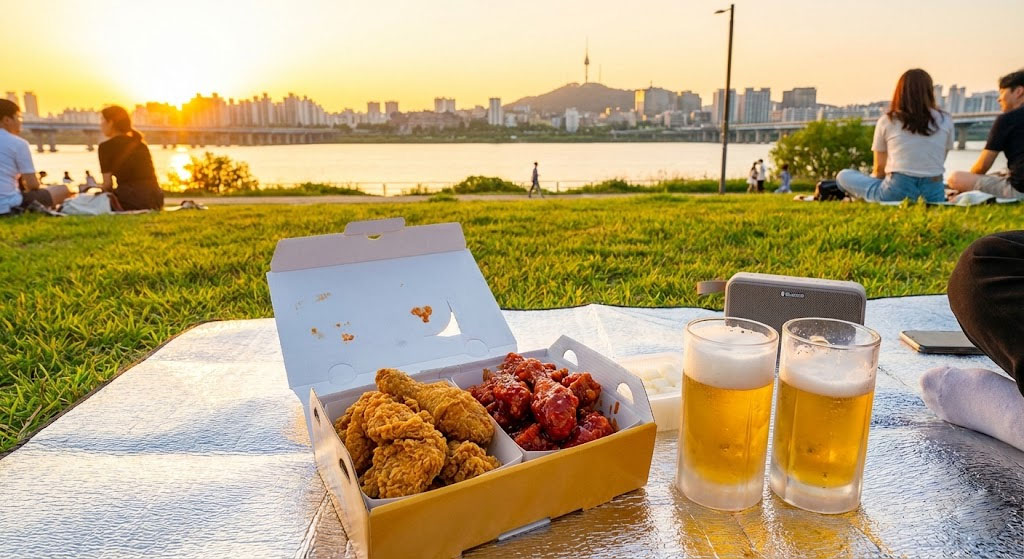
This is the legendary culture of Chimaek (치맥), and experiencing a seamless Korean fried chicken delivery to a public park is an absolute must-do culinary adventure. Here is the science behind the chicken and the secret hack to ordering it without a physical address.
What Exactly is Chimaek (치맥)?
The word Chimaek is a widely used linguistic portmanteau. It combines “Chi” (from Chicken) and “Maek” (from Maekju, the Korean word for beer).
While fried chicken and beer exist globally, in South Korea, it is not just a meal; it is a highly structural social bonding ritual. It gained massive, explosive international fame through globally broadcasted K-Dramas (most notably My Love from the Star and Crash Landing on You), where characters are frequently seen comforting themselves with a box of crispy chicken and a cold pint. Today, it is the undisputed king of Friday night food culture in Seoul.
Why is Korean Fried Chicken Different?
If you think it is just like standard American fast food, you are in for a culinary shock. The secret to authentic Korean fried chicken lies in a highly specific, scientific cooking method: the double-fry technique.
- The First Fry: The chicken is fried at a relatively low temperature to thoroughly cook the meat and render out the excess fat from the skin.
- The Second Fry: After a resting period, it is flashed in fiercely hot oil.
This meticulous double-frying process creates a paper-thin, incredibly brittle crust that famously shatters when you bite into it. Furthermore, the crust is chemically designed to remain crispy even when entirely drenched in sticky, complex sauces. The most famous variation is Yangnyeom (양념)—a brilliant, sticky glaze made from Gochujang (red chili paste), garlic, soy sauce, and sugar.
The Ultimate Hack: Ordering to Nowhere
Eating at a restaurant is fine, but the true local experience involves the magic of Korean fried chicken delivery.
South Korea possesses arguably the most advanced food delivery infrastructure on the planet. But here is what confuses most foreigners: If you are sitting on a random patch of grass in the massive Han River Park, you do not have a street address. How does the delivery driver find you?
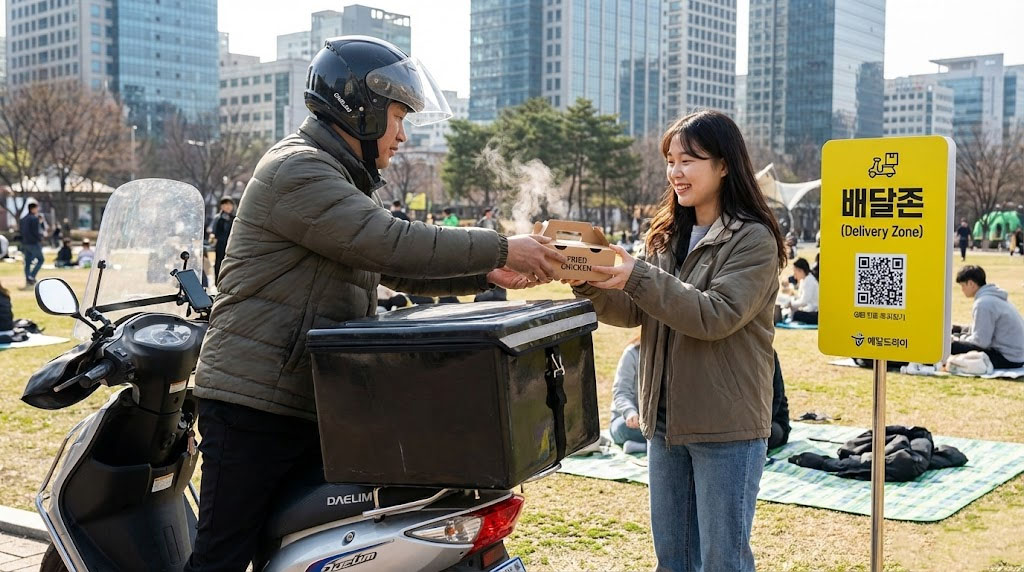
The Secret of the “Delivery Zones” (배달존)
The city has brilliantly solved this logistical nightmare. Major parks along the Han River (such as Yeouido 여의도 and Banpo 반포) have officially designated, brightly marked “Delivery Zones” (Baedal Zone / 배달존).
How locals execute the delivery hack:
- You find a comfortable spot on the grass and lay down your picnic mat.
- You open a local delivery app (or grab a flyer from the friendly distributors walking around the park).
- You set your delivery location to “Delivery Zone 2.”
- Within 30 to 40 minutes, a driver on a scooter arrives at that specific zone, calls your phone, and hands you a piping hot box of freshly fried chicken.
It is a flawless, highly efficient system that transforms a simple public park into an infinite, open-air dining room.
The Essential Park Equipment
To execute the Chimaek experience like a true Seoulite, you cannot just show up empty-handed. Locals always bring a specific “Han River Kit”:
- A Foil Mat (돗자리): Sold at every nearby convenience store for a few dollars. It is essential for blocking the moisture from the grass.
- Wet Wipes (물티슈) : The sticky Yangnyeom sauce is notoriously messy.
- A Mini Bluetooth Speaker (블루투스 스피커) : To create the perfect ambient atmosphere as the sun sets over the city skyline.
Conclusion
Korean fried chicken delivery to the Han River is the ultimate intersection of incredible culinary technique and highly advanced urban infrastructure. It perfectly encapsulates the fast, efficient, and deeply communal nature of modern Korean society. The next time you find yourself in Seoul on a breezy evening, grab a mat, order a box of half-and-half (original and sweet spicy), and enjoy the crunch.
🔜 Next Post Teaser
You have experienced the ultimate evening leisure of Chimaek at the river. But what happens when you wake up early the next morning and need a fast, satisfying breakfast on the go?
In South Korea, breakfast culture is remarkably fast-paced. If you walk near a busy subway station, you will smell sizzling butter, toasted bread, and sweet sugar. It is the iconic “Gilgeori Toast” (길거리 토스트 Korean Street Toast)—a heavy, sweet, and savory breakfast sandwich that breaks all the rules of a traditional Western morning meal.
Next up: [Korean Street Toast (Gilgeori Toast): The Sweet & Savory Breakfast Hack]
🔙 Previous Post
← Previous Post [Korean Kitchen Culture: A Practical Guide to Tools and Daily Habits]