You survived the intense Korean BBQ, you learned the drinking games, and hopefully, you drank your medicinal herbal recovery potion. Your headache might be fading, but your stomach? It is still entirely empty and incredibly fragile.
👉 (Missed the magical recovery potion? Read our survival guide here: [The Magic Potion: Does “Dawn 808” Really Cure Hangovers?])
In South Korea, we do not just drink water to recover. We eat to systematically reset our bodies. And absolutely nothing resets your system faster than a steaming bowl of Korean Hangover Soup Haejang-guk (해장국)—the country’s ultimate, centuries-old morning-after cure.
What is Korean Hangover Soup Haejang-guk?
The term Haejang (해장) literally translates to “to relieve a hangover.” Therefore, Korean Hangover Soup Haejang-guk is exactly what it sounds like: an entire category of restorative soups specifically scientifically and culturally designed to repair you.
These soups share three common traits: they are boiling hot, intensely savory, and packed with essential minerals. When eating this, locals often let out a deep sigh and use the word “Siwonhada” (시원하다). Literally, it translates to “refreshing” or “cool”—even though the soup is physically burning hot. That beautiful contrast between the hot temperature and the deeply soothing feeling in your stomach is the absolute magic of the dish.
The Royal Origin: 19th-Century VIP Delivery
This concept is not a modern invention. During the late Joseon Dynasty, wealthy nobles and government officials ordered a luxurious, early-morning version called Hyojonggaeng (효종갱). To keep it warm during the cold dawn hours, the heavy delivery pots were wrapped entirely in thick cotton.
Think of it as the 19th-century equivalent of premium VIP food delivery. It was not mere street food; it was highly nutritious recovery fuel designed exclusively for the elite.
Level 1: Seonji (The Traditional Blood Soup)
The most traditional and historically accurate version of this soup contains congealed ox blood (Seonji 선지). Visually, it can be intimidating to unaccustomed foreigners, resembling blocks of dark, savory pudding floating in a rich broth.
However, nutritionally, it is an absolute powerhouse. It is incredibly high in absorbable iron, pure protein, and vital minerals depleted by alcohol. This version is for diners who want the original, uncompromising “warrior-style” bodily reset.
Level 2: Gamjatang (The Modern Favorite)
If you are searching for the most universally popular and accessible Korean Hangover Soup Haejang-guk today, it is not the blood soup. It is Gamjatang (감자탕), a robust, spicy Pork Back-Bone Stew.
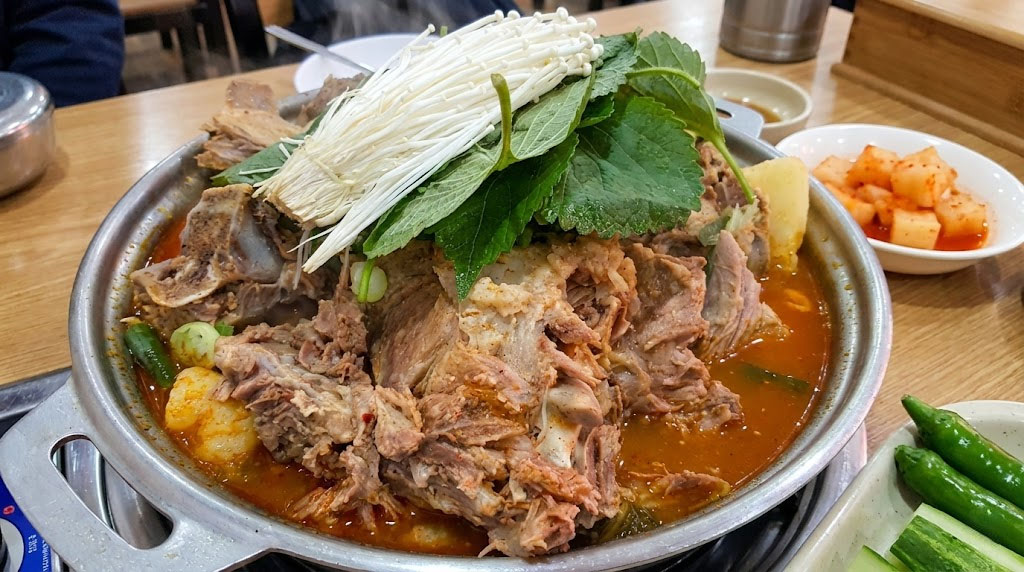
There is a fascinating linguistic misunderstanding with this dish. “Gamja” translates to “potato” in modern Korean, leading many tourists to wonder why a pork stew is named after a vegetable. However, culinary historians note that “Gamja” in this specific context actually refers to the anatomical name of the specific pork spinal bone used to brew the broth! So even if you do not see many actual potatoes floating in your bowl, you are eating the authentic, bone-deep dish.
If you wander into popular districts like Seongsu-dong in Seoul—famous for its trendy cafes—you will inevitably find legendary, 24-hour Gamjatang restaurants packed with locals at 4:00 AM, slowly ripping the tender meat off the massive pork bones.
How to Eat Like a Local (The K-Dessert Rule)
To fully experience this dish, you must follow the local ritual:
- Taste the Broth: Before adding anything, sip the rich broth flavored with earthy perilla leaves and wild sesame seeds.
- The Rice: You can dip your rice in the soup, but many locals just dump the entire bowl of rice directly into the boiling pot.
- The Cleanser: Eat it alternating with Kkakdugi (crunchy, cubed radish kimchi) to cut through the heavy pork fat.
The Grand Finale: Do NOT finish all the soup! Leave a small amount of the thick, reduced broth at the bottom of the pot. The restaurant staff will use that remaining liquid to fry rice, roasted seaweed, and sesame oil directly at your table. The rice absorbs the concentrated pork flavor and crisps up on the bottom. Locals humorously, yet seriously, refer to this savory fried rice as “K-Dessert.”
Does It Actually Work? The Science
Scientifically, yes. It is not just a cultural placebo; it is basic biology.
- The highly spicy broth dramatically increases blood circulation.
- The high sodium content instantly restores lost electrolytes.
- The dense animal protein stabilizes crashing blood sugar levels.
- The extreme heat promotes sweating, which helps flush remaining toxins from your pores.
It is highly functional culinary science. That is exactly why Korean Hangover Soup Haejang-guk has proudly survived for centuries as the ultimate weekend savior.
🔜 Next Post Teaser
Now your stomach is full, your hangover is cured, and you feel alive again. But as you walk out of the restaurant, do you feel that heavy afternoon food coma approaching?
In South Korea, we do not immediately rush to a fancy Starbucks after eating a heavy, spicy soup. Instead, we look for a tiny machine near the restaurant exit and tear open a tiny “Yellow Stick.” It is incredibly sweet, heavily creamy, and arguably the most important post-meal ritual in the country.
Next up: [Korean Restaurant Coffee Machine & Maxim Mocha Gold: The 90ml Secret]
🔙 Previous Post
← Previous Post [The Magic Potion: Does Dawn 808 Really Cure Hangovers?]