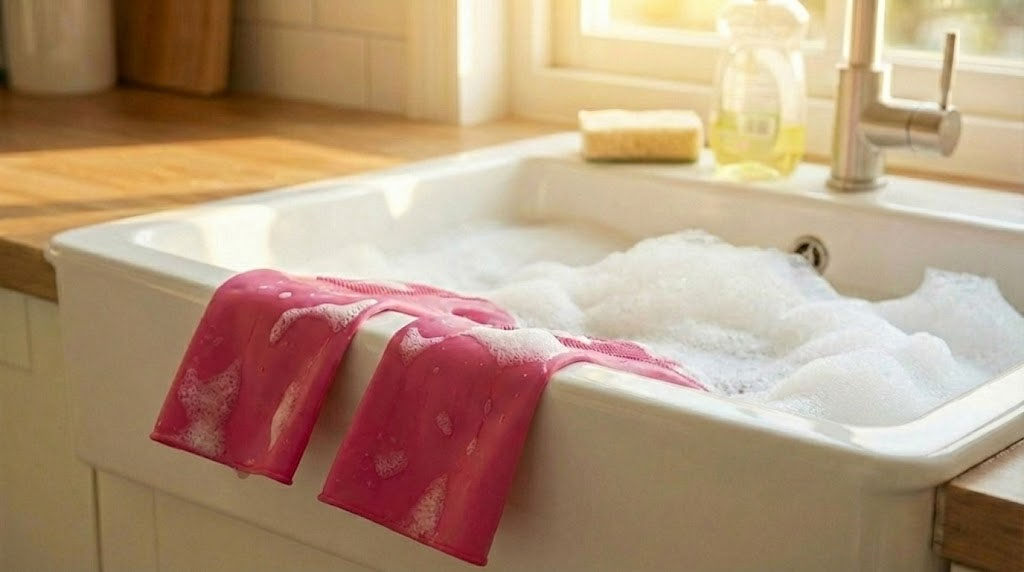
If you have ever visited an authentic South Korean home, you probably noticed one incredibly specific thing resting at the kitchen sink: a pair of bright, neon pink Korean rubber gloves (Gomu-janggap 고무장갑).
To an outsider, they might look like a simple, oversized household cleaning item. In reality, they are one of the most essential and highly engineered tools in traditional Korean kitchen culture. They are significantly thicker, much longer, and infinitely more durable than typical Western dishwashing gloves.
But why does almost every single Korean household deeply rely on this specific pink kitchen armor? Let’s break down the five practical, cultural, and scientific reasons behind their undisputed popularity.
1. Superior Heat Resistance (The Sterilization Culture)
In traditional Korean culinary culture, hygiene is paramount. After eating greasy meals like pork belly (Samgyeopsal) or spicy red chili stews, dishes must be washed using scalding hot water to melt the fat and completely remove heavy food residue.
Thin, disposable supermarket gloves simply cannot handle this extreme level of heat; they will leave your skin burning. High-quality Korean rubber gloves are manufactured with thick layers of natural latex specifically designed to act as thermal armor, protecting bare hands from high water temperatures. This makes them ideal for heavy, daily, high-temperature dishwashing.
2. Extra-Long Forearm Protection
One of the most universally annoying frustrations with standard short gloves is dirty dishwater inevitably splashing and leaking inside the cuff.
Most authentic Korean dishwashing gloves are purposefully designed to extend well past the wrist—often reaching halfway up the user’s forearm. This extended cuff architecture physically prevents soapy, contaminated water from entering the glove and soaking your sleeves. It is a massive functional upgrade born out of pure domestic practicality.
3. The Strong Non-Slip Grip
The palms and fingers of these gloves are not smooth; they are heavily and aggressively textured.
This design drastically improves physical friction when handling highly slippery glass bowls, heavy ceramic plates, or washing large stainless steel pots. Even when entirely submerged in thick soap bubbles, the grip remains completely stable. That unwavering reliability makes them the only tool suitable for safely scrubbing heavy, traditional earthenware pots (Ddukbaegi 뚝배기) and massive Kimchi storage containers.
👉 (Speaking of heavy Kimchi containers, did you upgrade your fridge storage yet? Read our cultural guide here: [Best Stainless Steel Food Containers for Kimchi])
4. Long-Term Sustainability
Cheap, thin cleaning gloves often puncture or tear within a few weeks. In contrast, high-quality Korean rubber gloves can easily last for several months under rigorous, daily use.
Many local households treat them as long-term, sustainable kitchen investments rather than cheap disposable items. This heavily reflects South Korea’s broader domestic preference for durable, “buy-once, use-long” household products that minimize environmental waste.
5. Cultural Identity: The Pink Symbol
The iconic, blinding pink color is not a random aesthetic choice. Since the 1980s, when pink latex became widely distributed in local manufacturing markets, the color became strongly, almost exclusively, associated with domestic home cooking and the image of a dedicated mother (Mamison 마미손 translates to “Mom’s hands”).
Today, the pink color is a visual cultural icon. If you see them hanging over a sink, you instantly recognize the deep cultural connection to an authentic Korean home.
The Anatomy of Authentic Kitchen Armor
What actually separates these cultural icons from standard cleaning equipment? The secret lies in the material science.
Most authentic pairs are constructed from pure natural latex, a material widely utilized in global protective equipment (Wikipedia) due to its incredible elasticity, puncture resistance, and complete water impermeability. When looking at the anatomy of this tool, you will always find:
- Thick Natural Latex: For high-temperature thermal protection.
- Extended Cuffs: To prevent water intrusion.
- Reinforced Fingertips: The areas most prone to tearing are structurally thickened.
FAQ
Are Korean rubber gloves safe for hot water?
Yes. Korean rubber gloves are typically designed to handle higher water temperatures used in daily dishwashing.
Why are Korean rubber gloves usually pink?
The pink color became common in Korean markets decades ago and eventually became associated with home kitchens.
Conclusion
Ultimately, Korean rubber gloves are not just colorful cleaning accessories. They are highly practical, culturally significant tools meticulously designed for hot water sterilization, a steadfast non-slip grip, and impressive long-term sustainability. Understanding why they are so ubiquitous provides a fascinating insight into South Korea’s intense focus on kitchen hygiene, domestic efficiency, and smart, traditional design.
🔜 Next Post Teaser
Now that we deeply understand Korean kitchen sanitation habits and how locals protect their hands, let’s move from the kitchen sink directly to the dining table.
If you sit down at a traditional Korean restaurant, you will notice the chopsticks are not made of wood or bamboo like in Japan or China. They are made of solid metal. Why are they so heavy? Why are they uniquely flat instead of round? And what does ancient royal history and poison have to do with it?
Next up: [Why Do Koreans Use Flat Metal Chopsticks? (The Historical Secret)]
🔙 Previous Post
← Previous Post [Best Stainless Steel Food Containers for Kimchi (Zero Smell, Zero Stain)]